What decisions and policies have made buying a home in San Jose increasingly difficult?
There’s an interesting story unfolding near Diridon Station in downtown San Jose.
Google proposed an ambitious redevelopment project called Downtown West. The approximately 80-acre development was designed to bring offices, housing, hotels, shops, and parks to an area right next to the SAP Center.
The City Council approved the project in 2021. But after demolition began, the larger development stalled. Some longtime businesses, including Patty’s Inn, were gone, while portions of the site remained vacant.
It’s a striking example of something happening throughout San Jose.
We need more housing. We have companies and developers interested in building it. Yet getting approved projects across the finish line can be incredibly difficult.
And the consequences are showing up in home prices.
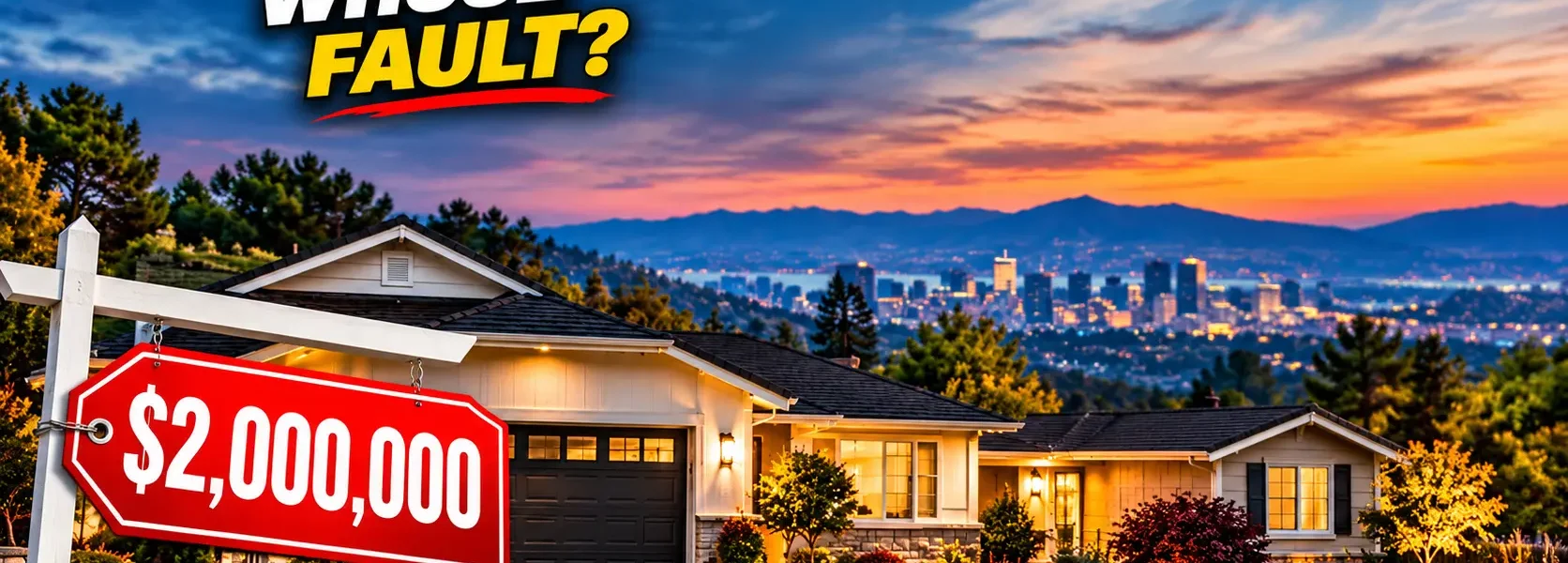
According to the California Association of REALTORS’ third-quarter 2026 Housing Affordability Index, the median existing single-family home price in Santa Clara County reached approximately $1.92 million. Only 23% of households could afford that median-priced home under the index’s standard assumptions.
That’s a minimum qualifying household income of approximately $489,200.
So how did we get here?
I want to walk through five major factors that have contributed to San Jose’s housing affordability problem.
Watch the original video:
1. The Cost of Building a Home Has Become Extremely High
Imagine a builder who wants to build a three-bedroom home in Cambrian.
Twenty years ago, the numbers might have worked for a young family looking for a starter home.
Today, that same builder faces a very different situation.
First, there’s the land.
A desirable buildable lot in San Jose can be extremely expensive. And in many established neighborhoods, the builder isn’t purchasing an empty lot. They’re buying an existing house that needs to be demolished before construction can begin.
Then come the development costs.
There are construction taxes, park fees, school fees, permits, insurance, and other expenses that add to the project.
California also has building requirements covering energy efficiency, solar installations, and electrical infrastructure.
Many of these requirements serve important purposes. But developers still have to account for their combined costs.
In the example I discuss in the video, building a new three-bedroom home could require a final selling price of around $2.4 million just to make the project financially viable.
That’s a very different definition of a starter home.
Approved Housing Doesn’t Always Become Actual Housing
Here’s another problem.
San Jose has approved thousands of housing units, but approval doesn’t guarantee construction.
A February 2026 city housing analysis identified approximately 13,000 units across 28 entitled projects that had been stalled for more than three years. The analysis also found that roughly two-thirds of the reviewed entitled units were financially infeasible under current market conditions.
Several projects approved years earlier still hadn’t broken ground.
Why?
Developers need financing. Banks need projects that make financial sense. If construction costs, interest expenses, and expected selling prices or rents don’t work together, a project may never move forward.
This is why housing approvals alone aren’t enough.
We need projects that can actually be built.
2. California Has Lost Much of Its Starter Condo Market
Remember how many first-time buyers used to get into the housing market?
They started with a condominium.
It was smaller than a single-family home, generally more affordable, and offered an opportunity to build equity before moving into a larger property.
That first step has become increasingly difficult to find in California.
Research published by SPUR in 2025 found that multifamily condominiums accounted for only about 3% of the new housing California added between 2011 and 2021.
Why are developers building so few condos?
One major factor is construction defect liability and the insurance costs associated with condominium development.
When developers sell individual units, they face potential legal exposure involving multiple owners. That risk can make condo construction significantly more expensive.
The SPUR analysis, based on research commissioned from the UC Berkeley Terner Center and Economic & Planning Systems, found that insurance for condominium builders can cost three to four times as much as insurance for comparable rental apartment projects.
So developers often choose to build rental apartments instead.
And that creates a problem for first-time buyers.
Instead of purchasing a smaller condo and gradually building equity, many young families remain renters for longer or compete for single-family homes that are already beyond their budget.
3. Proposition 13 Can Make Homeowners Less Likely to Move
Now let’s talk about Proposition 13.
This is one of California’s most important property tax laws.
Under Proposition 13, a property’s assessed value generally cannot increase by more than 2% per year, subject to the applicable assessment rules.
However, when a property changes ownership, it is generally reassessed at its current market value, unless a specific exclusion applies.
Consider two neighbors in Cambrian.
They live on the same street, in nearly identical houses.
One purchased their home 20 years ago. The other purchased a similar property last month.
Because the first homeowner has had a much longer period of limited assessed-value increases, their property tax bill could be considerably lower.
The newer homeowner, meanwhile, is generally assessed based on the more recent purchase price.
That’s a significant difference for essentially similar properties.
How This Can Affect Housing Supply
Now imagine you’ve owned your house for 20 years.
You have a relatively low property tax assessment and perhaps a mortgage rate that you would have difficulty replacing today.
You start thinking about moving.
But when you purchase another home, your property taxes could increase substantially.
So you reconsider.
You stay where you are.
For homeowners considering a move, deciding whether to sell or rent out their San Jose home can be a difficult decision.
This is one way Proposition 13 can influence homeowners’ decisions and potentially reduce the number of existing homes coming onto the market.
There is an important qualification, though.
California voters approved Proposition 19 in 2020. It allows certain eligible homeowners, including qualifying homeowners aged 55 and older and people with qualifying disabilities, to transfer their property tax base to a replacement principal residence anywhere in California, subject to specific conditions.
So moving doesn’t automatically mean losing your existing tax base in every situation.
But the eligibility requirements and financial implications are important.
4. CEQA Has Made Some Housing Projects More Difficult to Build
The fourth issue is CEQA, the California Environmental Quality Act.
Passed in 1970, CEQA was designed to ensure that major development projects consider their environmental impacts before moving forward.
That’s an important goal.
But over the years, environmental reviews and litigation have also become a source of delay for some housing developments.
A developer might spend years preparing plans, completing studies, and working through the approval process.
Then an environmental challenge or lawsuit could delay the project further.
Meanwhile, financing costs continue to accumulate, construction materials become more expensive, and the economics of the project can change.
Sometimes a development is delayed for years. Sometimes the project no longer makes financial sense.
California Has Started Changing the Rules
There has been some significant movement on this issue.
In June 2025, Governor Gavin Newsom signed Assembly Bill 130 and Senate Bill 131, introducing substantial CEQA and housing-related reforms.
These changes took effect July 1, 2025, with additional amendments signed later that year through SB 158.
Among other changes, the legislation created CEQA exemptions for certain qualifying urban infill housing developments and narrowed some environmental review requirements.
That doesn’t mean every housing development is now exempt from CEQA.
There are still eligibility requirements and environmental protections.
But these reforms provide a more streamlined path for certain housing projects.
And that’s encouraging.
The goal should be to protect the environment while making it possible to build the housing communities actually need.
5. The Amount of Land Available for More Housing Is Limited
This may be the biggest structural issue of all.
According to the City of San Jose, approximately 94% of residential land in the city is designated for single-family houses.
Think about what that means.
Most of the residential land is reserved for single-family housing, leaving a much smaller share designated for multi-unit development.
Historically, that meant you couldn’t simply take a typical single-family lot and build a duplex or small apartment building on it.
California has loosened some of these restrictions through newer housing laws, but the city’s land-use patterns still matter.
When land is expensive and opportunities to build more units are limited, the pressure on the existing housing supply increases.
San Jose’s Urban Growth Boundary
There’s another important planning decision.
In 1996, San Jose adopted an Urban Growth Boundary, also known as the Greenline.
The boundary was ratified by voters in 2000.
The idea was to encourage development within established urban areas while protecting surrounding hillsides, agricultural areas, and open space.
Coyote Valley is an important example of this policy approach.
In 2021, the City Council approved changes to protect more than 3,200 acres in Coyote Valley from urban development, preserving the land for agricultural, recreation, and related uses.
There were good reasons behind these decisions.
I’m not suggesting we should have paved over Coyote Valley.
Protecting open space and maintaining the natural environment matter.
But there is a trade-off.
When you limit where housing can be built outward, the city needs to find ways to accommodate more homes within its existing developed areas.
If the amount of housing that can be built on that land is also restricted, you create additional scarcity.
And when demand exceeds available supply, prices face upward pressure.
So Who Pays for All of This?
Increasingly, it’s the people who want to live and work here.
Some families move to Sacramento, Modesto, or the Central Valley.
Others leave California entirely for places like Texas, Arizona, Nevada, and Florida.
And it’s not just retirees selling their homes and moving somewhere cheaper.
It’s young professionals, college graduates, and families trying to get started.
I’ve had more conversations about people leaving California in recent years than I can remember.
These aren’t necessarily people who are angry with San Jose.
They’re families sitting around the kitchen table, looking at their finances and realizing they may have a better quality of life somewhere else.
I think that’s sad.
A lot of people love living here. They appreciate the jobs, the weather, the neighborhoods, and everything Silicon Valley has to offer.
They just can’t make the math work anymore.
Can San Jose’s Housing Affordability Problem Be Fixed?
I think there are encouraging signs.
California has introduced CEQA reforms.
San Jose has expanded housing incentives designed to encourage construction.
The city’s multifamily development incentive programs include reductions in certain construction taxes, inclusionary housing fees, and park fees.
The city also extended and expanded these incentives in January 2026.
There are additional opportunities to create housing through accessory dwelling units and other changes to California’s housing regulations.
But we’re still dealing with decades of decisions and a shortage that can’t be fixed overnight.
Even when a project gets approved, it takes time to secure financing, begin construction, and finally deliver completed homes.
And that brings us back to Downtown West.
The Google development was supposed to transform a large part of downtown San Jose.
But the delay shows how difficult it can be to turn an approved development into actual housing and commercial space.
San Jose’s High Housing Costs Didn’t Come From One Decision
When somebody asks why San Jose has become so expensive, I don’t think there’s just one answer.
We got here through decades of decisions.
Zoning restrictions.
Construction costs.
Development fees.
Property tax policies.
Environmental regulations.
Land-use decisions.
Many of these policies were created for perfectly reasonable reasons, and some have delivered real benefits to the community.
But when you put all of them together, you create a system where even people earning good incomes can struggle to buy a home.
And that’s the wall we’ve built.
So which of these five issues do you think San Jose should tackle first?
I’d love to hear your thoughts.
And if you know somebody who’s always wondering why it costs so much to live in Silicon Valley, share this article with them.
Thinking about buying or selling a home in San Jose? Kip and Tam | Barnard Group – San Jose
DRE# 01428934 | Compass
Website: https://kipandtam.com
Phone: (408) 515-8277