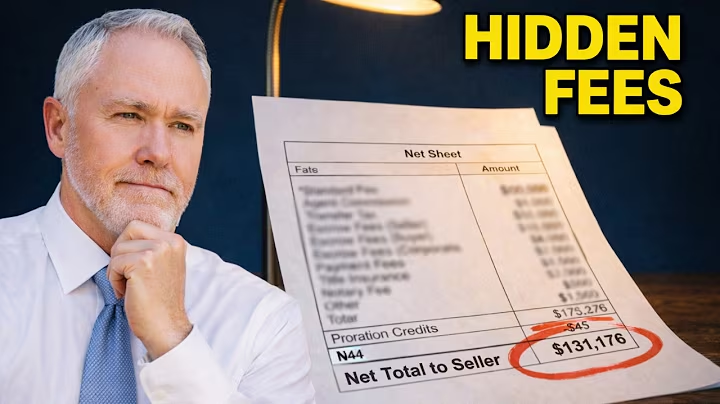
The $300,000 Tax Surprise San Jose Sellers Don’t See Coming
You bought your San Jose home probably 12 or 15 years ago. Maybe you paid $700,000 or $850,000. Now you’ve made your payments, built equity, and you’re looking at selling for somewhere north of $2 million.
That’s a great outcome. That’s real wealth.
But here’s the part nobody tells you before you sign that listing agreement: depending on how you handle the sale, the IRS and the state of California could have a very strong opinion about a significant portion of that profit.
For some sellers, we’re talking about a tax bill that could be north of $300,000.
Now, a quick note before we go any further. I’m a real estate broker. I’m not a CPA or a tax attorney. Nothing in this video is individual tax advice. What I’m going to give you is the landscape, the rules, the strategies, and the right questions to bring to your own tax professional.
Why This Video Is Not Tax Advice — And Why You Still Need It
Every situation is different, and yours deserves a real conversation with someone who knows your numbers.
I’m going to walk you through exactly how this works, what the rules are, and specifically what you can do to minimize what you owe.
Here’s a good example.
Take a retired couple, both of whom worked in education their whole careers, one a teacher and the other an administrator. They bought their house in 2004 for $480,000, and they were sitting on an offer just over $1.75 million.
It’s a beautiful outcome. Twenty years of appreciation, and they were happy and ecstatic.
But a couple of weeks before they closed, they sat down with their accountant for an unrelated, routine meeting. The accountant asked how the sale was going and started running the numbers on a whiteboard.
The room got quiet really fast.
Two Real San Jose Sellers, Two Very Different Outcomes
After the married couple’s federal exclusion of $500,000, they still had roughly $770,000 in taxable gain.
That gain stacked on top of their pension income for the year and pushed them into a federal tax territory they had never been in before.
Then add California’s tax rate, which does not give capital gains any special treatment. California taxes it like regular income.
They were looking at a combined bill somewhere between $230,000 and $270,000.
They closed their deal and were fine, but they wished they’d known about this six months earlier, not six weeks earlier, because there were decisions they could have made. Timing decisions. Documentation decisions. Decisions that might have changed that number meaningfully.
Now, flip that around.
Another seller in Willow Glen reached out to me before she even started thinking about selling. She’d done a kitchen and primary bath renovation back in 2019, and she kept every receipt. She also had questions about timing.
So we got her connected to a CPA early.
She understood her adjusted basis. She understood her exclusion. She timed her sale for a year when her other income was lower than usual.
The bill still existed. Gains of this size can still generate significant tax, but it was managed, planned for, and significantly smaller than it would have been otherwise.
Same San Jose market. Same basic scenario. Two completely different outcomes based entirely on when they started paying attention.
The tax code around the sale of a primary residence is actually one of the most generous provisions for individual taxpayers in the entire tax code.
There’s a $500,000 exclusion for married couples that most people have heard of, but almost nobody understands the full rules around it, and almost nobody is using all the tools available to them.
That’s what we’re going to look at.
Most married couples selling a primary residence know they can exclude up to $500,000 of profit from federal capital gains tax.
How the $500,000 Federal Exclusion Actually Works
Single filers get $250,000.
That part everybody’s heard. What they haven’t heard is that the rules around qualifying have some flexibility that most sellers don’t know to use.
Here’s what the IRS requires.
You must have owned the home and used it as your primary residence for at least two of the last five years before the sale.
Two out of five.
And here’s the part that surprises people: those two years do not have to be consecutive.
You could have lived in the home for one year, rented it for two while you were relocated for work, and then moved back in for another year and still qualify.
The two-year clock is cumulative, not continuous.
There’s also a provision called the partial exclusion. If you haven’t hit the two-year mark but you’re selling because of a job relocation, a health issue, or what the IRS calls unforeseen circumstances, you can still claim a proportional exclusion.
For example, if you lived there for 14 months out of the required 24 and then got transferred to Austin for work, the IRS may allow you to claim roughly 58% of the full exclusion.
For a married couple, that’s still close to $290,000 in excluded gain.
Before you assume you don’t qualify, talk to a CPA.
The rules have more flexibility than the headline number suggests.
And there’s one more thing on this point that matters for a very specific group of sellers.
The Two-Year Rule Has More Flexibility Than You Think
If you’re a surviving spouse and you sell within two years of your spouse’s death, you can still claim the full $500,000 exclusion, not the $250,000 single-filer limit.
After that two-year window closes, you’re back to $250,000.
That’s a hard deadline that widowed homeowners in San Jose can miss because nobody tells them it exists.
If this applies to you or someone you know, that clock is running right now.
Here’s something that almost nobody getting ready to sell understands: the number you pay taxes on isn’t your sale price minus what you bought it for.
It’s your sale price minus your adjusted cost basis.
And that number can be meaningfully different.
When you sell your home, the IRS lets you add the cost of capital improvements to your original purchase price. That adjusted total is your cost basis.
The higher your basis, the smaller your taxable gain.
The Surviving Spouse Deadline Most Sellers Miss
Capital improvements are permanent upgrades that add value or extend the useful life of the home.
This could include a new roof, a new HVAC system, a kitchen remodel, a bathroom addition, or an ADU. It can also include new windows, solar panels, or a permitted addition.
Regular maintenance does not.
Painting a room, fixing a leaky faucet, or replacing worn carpet are repairs, not improvements.
Here’s where San Jose sellers specifically leave a lot of money behind.
Silicon Valley homeowners renovate constantly. A kitchen in 2018, a primary bath in 2020, a new HVAC in 2022.
But if you didn’t keep your permits, invoices, and receipts dated, organized, and documented, the IRS will not take your word for it.
Adjusted Cost Basis and Why Your Receipts Are Worth Real Money
A $200,000 kitchen and bath renovation that you can document increases your cost basis by $200,000 and reduces your taxable gain by $200,000.
So at a combined federal and state rate that can approach 35% to 37% for a high-income year, that’s potentially up to $70,000 you wouldn’t owe.
That’s real money.
If you renovated and don’t have the documentation, start pulling together what you can: bank statements, contractor records, and permit histories.
Santa Clara County’s portal goes back further than most people think. Even partial documentation is better than none.
And if you’re planning to sell in the next two to five years, start that file now.
After closing, it’s too late.
So I’ll be real with you. This is the part where California being California actually costs people money in a way most sellers don’t fully grasp.
The federal government taxes long-term capital gains at preferential rates depending on your income: 0%, 15%, or 20%.
California does not do this. California taxes capital gains, both short-term and long-term, as ordinary income. At the top end, that’s 13.3%.
There is no discount for having held the property for 30 years.
How California Taxes Capital Gains Differently Than the IRS
For a Silicon Valley seller, the real tax stack on gains above the exclusion looks like this:
Federal long-term capital gains at 15% or 20%, plus a 3.8% net investment income tax if your income crosses $250,000 as a married couple, plus California tax of up to 13.3%.
Combined, that’s a marginal rate that can hit 37% on the portion above your exclusion.
Here’s where timing matters more than most people realize.
The year that you sell determines what other income gets stacked with your gain.
A couple where one spouse retired, took a sabbatical, or had lighter stock vesting in a given year may find their combined income sits in a lower federal bracket.
The difference between a 15% and 20% federal rate on a $500,000 taxable gain is $25,000.
That’s real money for a decision that costs nothing: just timing.
You’re not obligated to list in any particular month.
If you’re within six to 12 months of a significant income change, such as retirement, a career transition, or a year when vesting is lighter, that conversation with a CPA before you pick your listing date is worth having.
It doesn’t always move the needle, but sometimes it moves a lot.
Timing Your Sale Around Your Income Year
I know what some of you are thinking.
This sounds like it requires a CPA, a financial planner, and an estate attorney just to sell a house.
That’s fair.
Most sellers don’t need all three simultaneously, but they do need a CPA. And they need that conversation before they sign a listing agreement and put their home on the market, not three weeks before closing.
Here’s the reality.
The median single-family home price in Santa Clara County has crossed the $2 million mark. If you bought more than a decade ago in Willow Glen, Cambrian, or Almaden, your gain is almost certainly above that exclusion limit.
That means the tax is real, it’s significant, and it responds to planning.
A two-hour CPA consultation before you list costs a few hundred bucks. The decisions that come out of that meeting could be worth multiples of that.
This isn’t complexity for its own sake. It’s the math of where this market is.
What to Do Before You List — The CPA Conversation
My name is Kip, and I’ve been a licensed broker for over 20 years here in Silicon Valley.
Besides being a top producer, I’ve sat on the ethics committee here for over a decade. I’ve also managed and grown an office for the number one brokerage in the country, and I’ve overseen billions of dollars in sales.
What I love more than anything is helping buyers and sellers here in Silicon Valley.
And as always, I’m a broker, not a CPA. Take everything in this video to your tax professional before you make any decisions.
How these rules apply to you depends on your specific numbers.
That conversation is worth having before you list your home to sell.
What I can tell you from 20-plus years in San Jose is this: the sellers who come out ahead aren’t always the ones who got the highest offer. They’re the ones who understood their full picture before they made these decisions.
The exclusion rules, their cost basis, and their income timing are knowable. They just require some attention before closing, not after.
That’s the whole point of this channel. Not to sell you anything, just to make sure you’re walking into one of the biggest financial decisions of your life with real information in your hands.
If this was useful, subscribe. There’s a whole lot more where this is coming from.
Thanks for watching, and I’ll see you in the next video.