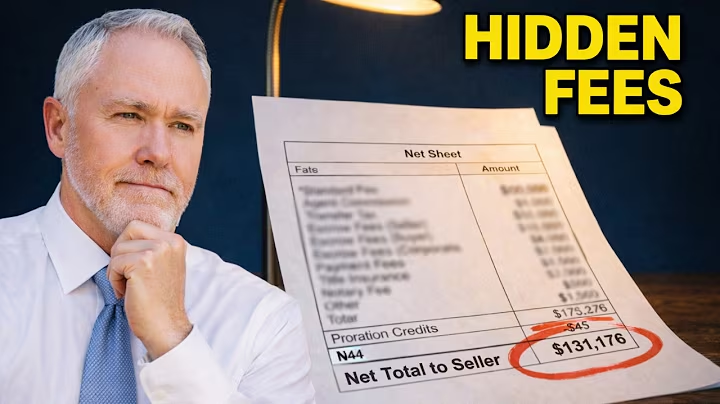
Really Cost San Jose Sellers
Today, I’m going to tell you everything you need to know about what you have to disclose and how to properly disclose it when selling your home here in San Jose, and why getting it wrong can follow you long after the sale is done.
Most homeowners have no idea how to do it right, especially those trying to sell by themselves.
My name is Kip Barard, and I’m not your average agent here in San Jose. I’m not afraid to tell you what you need to hear. So, let’s get into it.
Here’s what catches most people off guard: your disclosure obligation doesn’t end when the deal is done. It doesn’t end when you hand over those keys to the new buyers.
It follows you around.
A lot of people don’t understand that after the sale is done, the checks have cleared, and you’ve moved out, a buyer’s attorney can still come after you.
I’ll tell you exactly how that happens and, more importantly, how you protect yourself from it happening to you.
Let me give you a real example.
A homeowner decides to sell on his own. In his disclosures, he tells the buyer the roof is about 10 years old, there’s been no prior issues, and there’s nothing to worry about.
The sale closes in 30 days, and he feels great about it.
Chapter 2: Your Disclosure Obligation Doesn’t End at Closing
Six months later, the rains come, and they come hard that year. The new buyer starts seeing water coming in. Not a small drip, but a real leak.
So, he calls a roofer.
While the roofer is up there doing his thing, the neighbor wanders over, just casual, the way neighbors always do, and says, “Looks like that roof is about done, huh?”
The buyer says, “What do you mean?”
The neighbor says, “Well, I saw a couple of roofing trucks out here giving estimates before he put it on the market. I guess he decided not to put a new roof on, but yeah, he definitely knew about those leaks.”
So, the buyer went back to what the seller had put in writing. Nothing about leaks. Nothing about estimates from roofers.
They hired an attorney, and the attorney didn’t hesitate. He told them they had a clear case for non-disclosure.
The seller ended up paying for a brand-new roof out of pocket just to keep this thing from going to court because, once he talked to his own attorney, he knew he was going to lose.
And that’s really the whole point.
Disclosures aren’t just something you owe the buyer. They are the single most powerful legal protection that you have as a seller.
If you told them everything you knew in writing and they bought the house anyway, it’s really hard for them to come back after you later.
The sellers who end up in legal trouble after closing are never the ones who disclose too much. It’s always the ones who disclose too little.
Chapter 3: Real Example: The Roof That Followed a Seller Home
Usually, it’s not because they were trying to hide something. It’s because nobody walked them through the process properly.
So, here’s how I’ll break it down: three things every seller in California needs to understand before their home goes on the market, whether you’re working with an agent or going it alone.
The first is the Transfer Disclosure Statement. You might have heard it called the TDS if you’ve been online. If you bought a home before, you’ve signed one on the buyer side.
Now, filling it out as a seller is a completely different experience.
It’s not something a real estate agent made up. It’s required by California state law on every home sale and has been since 1987. There’s no getting around it.
The mistake sellers make is treating it like a checklist, something to just get through. But the TDS isn’t asking about the current condition of your house. It’s asking about your knowledge, what you’ve lived through, and what you’re aware of.
Those are two entirely different things.
Here in Northern California, sellers who are represented by an agent will typically order a pre-sale inspection before they ever come on the market. That report goes into the disclosure package, and buyers are largely making their decisions based on what’s in it.
Buyers can still get their own inspections, but having one done up front makes for a smoother sale and a lot less renegotiation after the contract is accepted by both parties.
Here’s the thing, though: an inspector can only see what’s in front of them on the day they show up. They can’t see what you’ve experienced over 10 or 15 years of living in that house.
A good agent is going to push you a bit on this.
For instance, I’ll sit down with a seller and say, “Tell me everything you know about this house because what’s in that report is what one inspector saw on one day.”
What’s in your head is years of small repairs, things you’ve noticed, and things you may have forgotten about.
A complete disclosure process is meant to get you thinking about those things.
And I’ll tell you something from my years managing a real estate office that I think about every once in a while when we get to this part.
We had an agent whose seller was being sued after the sale.
Here’s what happened.
During the listing appointment, the seller was walking the agent through the property, proud as could be, showing off his incredible outdoor kitchen that he built himself. It had a built-in gas barbecue, concrete counters, the whole thing. It was beautiful.
He was a landscaping contractor, so everyone just assumed he knew what he was doing.
But six months after closing, the new owners went to fire up the grill.
Nothing.
So, they called a contractor, who told them the gas piping underneath the concrete slab was the wrong type entirely. It had been leaking underground.
The estimate to fix it was $50,000. That included cutting through the concrete, digging it all up, replacing every inch of the piping, and reinstalling the whole kitchen.
So, the buyer sued the seller for non-disclosure because nowhere in the disclosures did it mention that the kitchen was owner-built, and nowhere did it mention that permits had never been pulled.
Then the seller turned around and sued the agent because he claimed he had told the agent he built it himself, and the agent never said a word about disclosing it. He never walked him through it and never asked the right questions.
Chapter 4: The Transfer Disclosure Statement Explained
The disclosures require listing any improvement done by the homeowner. So, that’s a failure of fiduciary duty.
By the time the attorneys got involved, a $50,000 problem had turned into a $180,000 problem.
Both of them could have prevented every bit of it if the seller had simply disclosed that the outdoor kitchen was owner-built without permits.
That’s it. That’s all it would have taken.
Chapter 5: The Seller Property Questionnaire — The Form Most Sellers Miss
The second thing I’ll discuss catches most people completely off guard, especially if you’re thinking about selling without an agent.
So, pay close attention here.
There’s a second form that goes even deeper than the TDS. It’s called the Seller Property Questionnaire, or the SPQ, and most homeowners have never heard of it.
The SPQ covers things the TDS doesn’t even touch: permit history, insurance claims, neighbor disputes, HOA issues, roof condition, a much more detailed water intrusion history, and work done without permits.
This thing is thorough.
And when a listing agent represents a seller, it’s standard practice. It goes in the package automatically.
Now, here’s the problem for sellers going it alone.
This form is only available to licensed real estate professionals. You can’t download it off the internet.
So, a homeowner selling by themselves fills out the TDS, thinks they’ve done their job, and has no idea there’s an entire second layer of questions that they haven’t even addressed.
California law requires sellers to disclose anything that materially affects the value or desirability of the property. Anything a buyer would want to know that they couldn’t easily find out on their own.
A buyer’s attorney doesn’t need to prove you skipped a form. They just need to show you knew something and didn’t share it.
In California, concealing a material fact is treated as fraud. That’s not me being dramatic. That’s just how the law works here in California.
So, if you’re working with an agent, that SPQ should be in your disclosure package. It should be automatic. If it’s not, ask.
Chapter 6: Disclosing Beyond the Physical: Neighbors, Permits, and More
And if you’re thinking about selling on your own, just understand this is a legal framework built with professionals in it. That SPQ form is the most obvious gap.
It’s not the only one.
After overseeing thousands of transactions, I can tell you the sellers who walked away completely clean were always the ones with the most thorough disclosure packages, never the thinnest ones.
Now, the third thing surprises people the most.
Your obligation as a seller isn’t just about the physical condition of the house.
There was a court case in the 1980s called Easton versus Strassburger. That case set the standard for how disclosure works in California.
The short version is this: if you know something a reasonable buyer would want to know before purchasing your home, you have a legal duty to share it, even if you can’t see it, even if it’s not a crack in the wall or a leaky roof.
That means things like an ongoing dispute with a neighbor, something that happened on the property, a noise pattern from a nearby property that you’ve lived with for years, or even a death on the property within the last three years. California law specifically requires that one.
I’ve seen this come up, too.
A buyer closes on a home here in San Jose and, a few weeks later, they’re introducing themselves to the neighbors and find out there’s been a long-running dispute between the previous owner and the house next door.
Noise complaints, city citations, years of it, back and forth.
The seller knew. He just didn’t think of it as a disclosure item because it wasn’t a physical problem with the house.
But that absolutely affected the desirability of the property. The buyer had a legitimate legal argument.
So, before you put your home on the market, sit down and really think. Not just about what shape the house is in, but about what you know and what’s happened here.
What has your actual experience of living in this neighborhood been?
What would you want to know if you were the one buying this home?
That’s the standard California holds you to.
Chapter 7: Does Disclosing Everything Hurt Your Negotiating Position?
Now, I know what some of you are thinking.
If I disclose everything, am I just handing buyers ammunition to negotiate me down on my price?
And I hear this a lot. I’ll be straight with you: yes.
Sometimes a disclosure leads to a negotiation. A buyer asks for a credit, they want a repair, or they offer you less than you think your property is worth.
That happens.
But here’s what I’ve watched play out over and over.
When both sides are still at the table, when there’s a process for working through it, deals adjust and they close.
I’ve seen sellers in Willow Glen disclose unpermitted additions that had been there since the 1970s. Everything was documented and disclosed properly.
The buyer had a contractor evaluate it before making their offer, they negotiated a fair price, and the deal closed without drama.
That’s how it’s supposed to work, guys.
What actually kills deals or turns into lawsuits is when a buyer discovers something on their own during the escrow period or after they’ve moved in.
That’s when trust breaks down completely. That’s when people stop talking and start calling attorneys.
And in over 20 years of doing this in San Jose, I have never seen a thorough, honest disclosure package kill a deal that was otherwise solid.
What I have seen is incomplete disclosures turn clean sales into legal nightmares.
Chapter 8: How to Protect Yourself and Close Clean
So, the question isn’t whether something is going to come up in an older home. Something always does.
The question is whether it comes up at the right time, with you still protected, or whether it follows you around.
Disclosures aren’t the exciting part of selling your home, but they’re the part that determines whether your sale is actually finished when it closes or whether it’s still with you years later.
Do it right. Get it all in writing.
And if you need help figuring out what that looks like for your situation, reach out. That’s what I’m here for.
Hit subscribe. There’s a lot more where this came from. And I’ll see you in the next one.